







Jesse Reichek
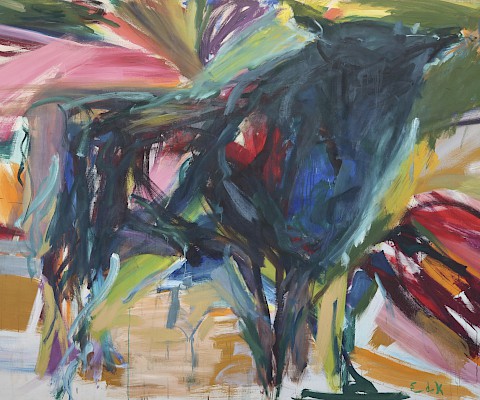
The work of California artist Jesse Reichek reflects a unique synthesis of painting and spirituality, including nearly 3000 works produced on a daily basis throughout the second half of the twentieth century. For more than half a century these paintings seek to express the structure of process, the process of creation, and the creation of relationship. In these paintings, symbol, image and perspective are banished. Reichek examines the structure in the incidents of experience... (askarts.com)---"Abstract painter who shunned the gallery scene, revered Jesse Reichek gets a posthumous exhibit"Jesse Hamlin, San Francisco Chronicle Staff WriterMonday, November 21, 2005Like everybody else in Paris in the late 1940s, Jesse Reichek had to carry a French ID card. He listed his occupation as shoemaker. "He did not want to use the word artist," said the painter's wife, Laure, a lovely French woman who made a life with the Brooklyn-born Reichek for 55 years, the last 35 in the serene isolation of the west Marin hills near Petaluma. "There were so many people at the time sitting at the Cafe Flor, calling themselves artists. Then what the hell are you doing there at 2 in the afternoon? He couldn't stand that." A remarkably disciplined man who created a vast body of pictures he chose not to show for three decades, Reichek, who died in July at 89, saw himself as a working painter. He had the good fortune to make his living as a design professor at UC Berkeley. A mystical abstractionist in the line of Klee, Kandinsky and Mondrian, he made his name in New York and Paris in the 1950s and '60s but withdrew from the art world and just painted, seeking a connection with some unknowable divine presence. The fruits of his labor are on display in a year-long, rotating retrospective put together by Reichek's extended family -- his wife and two sons, colleagues and former students from around the country, Petaluma neighbors and merchants who gave equipment gratis. Reichek's rigorous works hang in a weathered old warehouse they renovated, behind the rural Marin French Cheese Factory, a few miles from the Reichek place. In keeping with his egalitarian ethic, it's free, and nothing's for sale. The retrospective opened with the painter's potent I Ching series, comprised of 64 9-by-6-foot canvases exploring the 64 hexagrams of the ancient Chinese text. The current show features about 300 drawings and paintings that grew out of Reichek's immersion in the kabbalah, the mystical Jewish text that ponders the tetragrammaton, YHWH, the four Hebrew letters said to form the unspoken name of God. The painter put them through countless permutations. They morph into kinetic raspberry and pumpkin-colored shapes moving across canvas banners, and bold dancing forms that suggest Southwest American Indian art. Still to come in the months ahead are Reichek's riffs on the Song of Songs and myths from many cultures about creation and death. Some paintings sing more than others, but seen as a whole, they reveal an intense mind in action, day after day, year after year, a life. "Our life was one big discussion on the meaning of life, and painting was inseparable from life," said Laure Reichek, a petite, energetic woman with blue eyes, short silver hair and an ear for language (she tosses off Yiddish phrases with a French accent). A country girl from the region of Berri in central France, her nurturing way was summed up in the banner her husband hung in the big barn-like studio looking north to a neighbor's cow pasture: "This work has been made possible by Laure." She was sitting in the simple, light-filled home she, her husband and their two sons, Joshua and Jonathan, built themselves, while living in tents, on 15 acres of land dotted with oaks and bay trees. She lives there now with Douce, a sweet old black Lab, two amiable donkeys, San Fran and Cisco -- Cisco likes to poke his big head in your car window and not budge -- and a shy mule named Luma. Big carp, one bought each year to celebrate the Reicheks' anniversary, swim in the pond out back in the company of native turtles. Laure (pronounced "lore'') planted the willow and liquidambar trees that color the garden she calls her little Giverny, after Monet. The big square living space, on this day warm with the smell of baking apples, was often filled with friends partaking of food, wine and conversation whose flow Reichek diagrammed on the spot. One of them was Virgus Streets, a student of Reichek's at Cal's College of Environmental Design in the '60s, who helped install the paintings and lights for the Cheese Factory show. "It was a labor of pure love. Jesse was a mentor," said Streets, who went into community development and design. He's one of many students who fell under the sway of the storytelling professor who focused on the social and political aspects of design, and the moral imperative not to diminish human dignity. "Jesse was the best example I know of someone working every day toward a purpose, to render his thoughts into a vision," Sheets said. He was blown away by Reichek's big I Ching paintings -- each composed of six continuous or broken lines in red or blue on a black field -- vibrating in that vast white space. One of Reichek's final wishes was to see those paintings all together for the first time. He died two months before the show opened. A political activist who championed the Free Speech movement, marched in Mississippi and protested the Vietnam and Iraq wars, Reichek was a big-league talker hungry for knowledge. But he rarely spoke directly about his painting. He thought art shouldn't persuade or manipulate, but rather let the viewer give it meaning. "He didn't want people to think they're getting answers. They're getting questions," said Berooz Tamdgidi, an Iranian-born sociology professor at the University of Massachusetts. He formed a bond with Reichek while studying architecture at Berkeley in the late '70s. It was Reichek's emphasis on "redesigning the social environment" that inspired him to switch to sociology. "I had this conspiracy theory that Jesse was there to push people out of architecture," laughed the sociologist, who decided that the problem with low-income housing wasn't the housing but the income. He flew out for the opening of the show. Other former students had come to visit from near and far -- South African architect Ken Simmons flew in from Johannesburg -- when word got out that their beloved prof had a weak ticker and probably wouldn't be around much longer. It says something about his effect on people that nine former students and colleagues named their sons Jesse after him. They include James Ackerman, the esteemed Harvard professor emeritus who wrote the text for the retrospective catalog, and Rabbi Jim Brandt, a onetime Berkeley architecture student who calls Reichek his rabbi, or teacher. One of the things that endeared students to Reichek was the way he used the rich tradition of Jewish storytelling, jokes and dialectic to charm and challenge. He came from an Eastern European Orthodox Jewish family, the son of an illiterate immigrant mother and a father who made a meager living selling furniture and devoutly studied Torah. Jesse hated the Orthodox Jewish school, or yeshiva, he attended. He rejected organized religion, but the discipline he got at yeshiva served him well as he pursued his own form of spiritual engagement. Reichek fell in love with painting after getting off at the wrong bus stop and wandering into New York's Metropolitan Museum of Art. He studied at the New Bauhaus in Chicago, where the faculty included artists who'd taught at the influential art and design school in Germany before the Nazis shut the Bauhaus down (Reichek worked with the Hungarian master Laszlo Moholy-Nagy). After serving as a camouflage instructor in World War II, Reichek painted in Paris for four years under the loose auspices of the Academie Julien, living on $75 a month from the GI Bill. He hung out with Saul Bellow, with whom he spoke Yiddish and played casino. He met Laure Guyot one night in a cafe and they were inseparable. "He was intense!" said Laure, 75, whose father, Sam Maur, was a vagabond painter who lived on a barge on the Seine. Her mother, a pianist of mixed French Canadian-Mohawk Indian parentage, died of an infection from a cut she got pulling a drowning person from the dirty river when Laure was 11 days old (the girl was brought up by her papa's parents). She recalled the first night she spent with Reichek. She got up around 4 a.m. to go to the bathroom and when she returned to bed, "he was reading Einstein. He had to know everything. He started with the Socratic principle that the unexamined life is not worth living. So you constantly examine your behavior, vis-a-vis the knowledge you acquire, and you constantly need to know more and go deeper. I knew him for 55 years, but I would need another 55 to plumb the depths of the stuff that was going on in his head." Reichek was making abstract pictures when she met him (he said Mondrian gave him the courage). He wanted to create his own formal and graphic vocabulary, a lexicon of calligraphic squiggles, fat snaking lines and mutating shapes, moving across grids of rectangles and squares. He used it to explore what he called "the structure of process" -- the systems underlying ever-changing forms and energies, the flux of life. Like others before him, Reichek blurred the distinction between figure and ground, negative and positive, creating tension and movement that in his best canvases give off a visual hum. He embraced the kabbalah's idea that the messiah -- "meaning anything you want," his wife said with a smile -- has arrived when you can read the white spaces between the black letters. Reichek showed his work at New York's prestigious Betty Parsons Gallery and at the Paris gallery of Cahiers d'Art, the journal published by Christian Zervos, the noted critic who in 1960 put out a book of Reichek's drawings with introductory comments by Bellow. In 1969-70, Reichek made experimental computer work with IBM engineers as part of the L.A. County Museum's big Art and Technology project that also featured work by Warhol, Rauschenberg and others. But after Parsons and Zervos died, Reichek soured on the gallery scene -- "Art had become an entertainment and a commodity," Laure Reichek said -- and quit showing. "His work could've been seen and collected a lot more if he'd been more of a mind to market it," said Berkeley architect Murray Silverstein, a student of Reichek's at Cal in the '60s who bonded with him during the Free Speech movement. Silverstein, who worked on the renovation of the Cheese Factory space, recalled Reichek as a "great rebel spirit and a great storyteller, a kind of Brooklyn street kid who joked about everything under the sun, a lefty who was angry at authority. He could be difficult. He came to certain convictions about painting and art, and they were kind of chiseled in stone for him." As Reichek's ideas about politics and design fell out of favor at the Berkeley architecture school, Silverstein added, he removed himself, retired in '79 and plunged into his painting, working to the music of Duke Ellington and Thelonious Monk. He organized anti-war efforts in Petaluma, where his wife helps the homeless and immigrant farmworkers. When Silverstein looks at Reichek's work, he sees Jesse and Laure. "The two of them created this world," he said. "She not only provided a wonderful environment for him in a very nurturing way -- great cook, homemaker, a terrific eye for everything -- she gave him the space to explore things. The work began with his ideas but eventually started to absorb a kind of intelligence that was hers. I think she gave him a capacity to love, and that comes out in his late work." Two months before he died, Reichek, in a wheelchair and with a failing heart that made his otherwise alert mind momentarily go on the fritz, went to the studio for the last time. He made some unaccountable blunder in a painting and called it quits, for good. He told his wife if he couldn't paint anymore, he didn't wish to live. "He stopped eating and drinking. That was his choice," she said. It was painful to watch, but she accepted his decision. They had talked about death for years, and he'd been reading "The Egyptian Book of the Dead." As he wished, Reichek died at home, on his own terms.