






Charles Clough
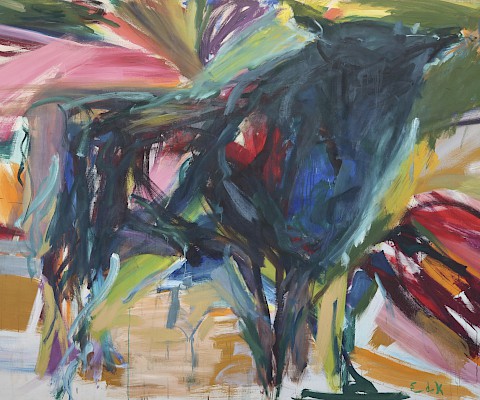
http://www.clufff.com/ 1-5-2011was born in Buffalo, New York in 1951. He established his studio in 1971 and founded Hallwalls Center for Contemporary Art with Robert Longo and CIndy Sherman in Buffalo in 1974. His art has been exhibited in over 60 solo and over 150 group exhibitions throughout North America and Europe and is included in the permanent collections of over 70 museums. Clough determined in 1976 that his life project would be to make “the photographic epic of a painter as a film or a ghost†which he refers to as “pepfog†and describes in Pepfog Clufff. In 2010 Clough painted one painting: O My Goodness, from which a facsimile print, book and movie were derived. Contact: charlie@clufff.com http://purple.niagara.edu/cam/special/Art_of_80s/Artists/clough.htmlCharles Clough was born in Buffalo, New York in 1951. He experimented with illustration and graphics as a teenager, but, as he states now, he first thought that "art was some kind of publicity thing you read about in Life magazine." After briefly studying graphic art at the Pratt Institute in Brooklyn, Clough attended the Royal Ontario College of Art in Toronto in 1970 - 71. Soon afterwards, he met the artist Robert Longo who, like Clough, had a studio space at the Ashford Hollow Foundation in Buffalo. Clough and Longo discussed the possibility of founding an artist-run presentation space. With the help of Ashford Hollow and many individual artists and administrators, Clough and Longo founded Hallwalls Contemporary Arts Center in 1974. Hallwalls grew to become an internationally-known center for performance, media, and the visual arts. Clough left Buffalo in 1978 for New York to focus on his own career as an artist. At this time he was working mainly in collage and appropriation, finger-painting on color magazine reproduction and then using further photography, collage, and painting to build up layers of imagery. These works were well-received, particularly given the movement toward appropriation and questioning of media imagery that was popular at the time.Clough also works directly with paint on canvas, using abstract imagery and a painting tool he calls "the big finger." He feels that this device brings a certain emotional distance to the physical act of painting. Clough still uses the "big fingers," but often resorts to other tools, including photography, continuing to explore an intellectual approach to the creation of imagery. CRITICAL EXCERPTS Charlotta Kotik, Charles Clough, Albright-Knox Art Gallery catalogue, 5/83"It would be hard not to see the allusions to Abstract Expressionism in the painted gestures in Clough's work. However, close scrutiny reveals that these too are illusionary since what we see is, in fact, the impeccable flatness of a mechanically reproduced surface. The two elements have equal importance—the results for which Clough is striving depend on this interaction of gestures and impersonal reproduction." Anthony Bannon, Buffalo News, 3/15/83 "Clough's process begins with mechanical reproductions of his own work, which are cut and pasted, assembled, marked over, drawn over, re-photographed, reassembled, drawn over, painted over, projected, imitated, made into books and so on...Finally, the work says something about the process, which is decidedly modern—a reclaiming process that is capable of replication, like modern media it claims its kin across channels—original works of art made into prints in books, frames in films, stills in photographs, scans across television, et cetera...by seizing the past of art and making it present, Clough creates new unities, swimming across time and merging old spaces into new ones...The idea of swirling is the grammar upon which the pieces are built..His all-over compulsion to fill a confining frame yields a bit at the edges—just enough to breathe with the work—" Alan Jones, Pecolo catalogue, 1985 "'As spontaneous as my work looks, it is all about development of the image.' Clough is clear about his motives: the quest for the lucky accident..'to reach that magical moment when you become so involved in the work—the sheer joy of making—that you achieve a sort of suspension of the ego.' Clough sees his painting as being about edges...'the kind of edges the ocean has on a humid, windy, day, of smoke and clouds, of the change in chemical states...' Clough is interested in simultaneity, in the way a static painting can operate in time. 'Paying attention to time in films by Michael Snow, Stan Brakhage, even Warhol, changed my sense of what time is in a painting.'" http://en.wikipedia.org/wiki/Charles_Clough 1-5-2011Charles Sidney Clough (born February 2, 1951, in Buffalo, New York) is an American painter. His art has been exhibited in over 60 solo and over 150 group exhibitions throughout North America and Europe and is included in the permanent collections of over 70 museums.[1]Early life and educationCharles Clough was born and raised in Buffalo, New York where he attended Hutchinson Central Technical High School. He then attended Pratt Institute in Brooklyn from 1969-1970 where the two-dimensional design teacher Joseph Phillips, introduced Artforum magazine to him. Clough dropped out and on January 5, 1971 decided that he would devote his life to art. He traded his sculptor’s assistant services for studio space with artist Larry W. Griffis Jr., at the Ashford Hollow Foundation’s 30 Essex Street former ice-house facility. From 1971-1972 he attended the Ontario College of Art and was introduced to the artists and galleries of Toronto, Ontario, Canada. He observed closely the organization of A-Space, a not-for-profit gallery which exhibited emerging artists. This model along with that of Artists Space in New York provided the example that Clough followed in forming Hallwalls Center for Contemporary Art.By 1973 many of the University at Buffalo’s and Buffalo State’s art professors had rented studios at 30 Essex Street. One of these, Joseph Panone, brought his student, Robert Longo and introduced him to Clough, which resulted in the program of exhibitions and artists’ visits which became Hallwalls in 1974. Larry W. Griffis Jr. and the Ashford Hollow Foundation shared its space and its Internal Revenue Service’s 501 c3 status to seek and be awarded grants by the National Endowment for the Arts and New York State Council on the Arts. Panone, his wife, Linda Brooks, Longo and his girlfriend, Cindy Sherman, Diane Bertolo, Jeff Catalano, Ken Davis, Kitty Hamilton, Joe Hryvniak, Gary Judkins, Pierce Kamke, Larry Lundy, Philip Malkin, Chris Rusiniak, Rick Zucker and Michael Zwack assisted in presenting, amongst many others, Vito Acconci, Kathy Acker, Laurie Anderson, Lynda Benglis, Ross Bleckner, Barbara Bloom, Eric Bogosian, Jonathan Borofsky, Chris Burden, Tony Conrad, Robert Creeley, Eric Fischl, Philip Glass, Jack Goldstein, Dan Graham, Robert Irwin, Sol LeWitt, Robert Mangold, Sylvia Mangold, Malcolm Morley, Ree Morton, David Salle, Julian Schnabel and Michael Snow.[2]In 1978 after separating Hallwalls from the Ashford Hollow Foundation, establishing its board of directors and obtaining its own 501 c3 status, Clough returned to New York City to pursue his art.[edit] ArtworkIn his autobiographical, Pepfog Clufff, Clough has written of the period following his commitment to art that: “my examination of impulses, desires, and intentions finally began to coalesce in my journal-like Studio Notes with which I have developed the themes and procedures which articulate my meanings to this day. At that point I had abandoned illustrational strategies for paint-as-material processes, generally, as established by Pollock and his progeny. My wood carving gave way to making maquettes for Tony Smith-like sculptures. My photographs reflected Walker Evans on the one hand and Jan Dibbets on the other.â€Pepfog Clufff includes the following categories of works: 1. The Arrow 2. The Composites 3. Flung, Stroked, Squeegeed, and Ground 4. The Studio Notes 5. The Photo Reveals and the Paint Conceals 6. Clouds 7. Paint Creatures 8. Male and Female 9. Group Portraits 10.The History of Foolish Hope 11. Old Masters and Utopias 12. C-notes 13. Display Models 14. The Airbrush Detour 15. The Big Finger 16. The Vortices 17. Sun Wei 18. Arena Painting 19. The Stereos 20. Sticks and Stones 21. The Polychromes 22. Tinnitus and the Movies 23. Caesura 24. The Zodiac Conclusion 25. The Zodiac Macros 26. The Terminal Painting 27. Stream 28. The Tributaries 29. The Westerly Sculpture 30. The Books 31. The Segue 32. Pepfog.[3]Pepfog Clufff includes "Chance and Choice," Clough’s statement of concerns, excerpted here: “My subject is a web of metaphysical categories including: 1. Unity: wholeness, integrity, fragmentation, connectedness, and cosmic parameters. 2. Identity: similarities and differences, sums of distinguishing characteristics, units of consciousness and processes of projection, introjection, and transference. 3. Freedom: the fixed limits of nature, the shifting limits of society, the free exchange of ideas, and the boundless imagination. 4. Creation: the process of nature as a metaphor for thought and action and the correlation of form and content to establish the symbolic realm. 5. Truth: the limits of nature, the nature of belief, and the interpretation of the ambiguous. 6. Utopia: progress or a timeless ideal, perfect moments or a state of grace. 7. Nothingness: death, oblivion, the absolute, the infinite and/or the unimaginable.†[4]Beginning in 1978 Herbert and Dorothy Vogel (New York City) began collecting Clough’s art and since then acquired over four hundred works, many of which were distributed to a museum in each of the fifty (United) States through a project implemented by the National Gallery of Art (Washington).[5] Clough has been awarded grants by National Endowment for the Arts (1982, 1989), New York State Council on the Arts (1983) and the Pollock-Krasner Foundation (2009). [1] His work was included in The Metropolitan Museum of Art’s The Pictures Generation, 1974–84, from April 21-August 2, 2009.[6][edit] Personal lifeCharles Clough is married to book designer Liz Trovato, and they are the parents of Edward George Clough (b. 1980) and Nicolas Henry Clough (b. 1982).[edit] References1.^ http://www.clufff.com2.^ Consider the Alternatives, 20 Years of Contemporary Art at Hallwalls, Edited by Ronald Ehmke with Elizabeth Licata, 1996, Hallwalls, Inc. ISBN 0-936739-20-73.^ Charles Clough, Pepfog Clufff, 2007, Lulu.com, ISBN 978–0–6151–7814–1 (free PDF for download: www.clufff.com)4.^ Charles Clough, Pepfog Clufff, 2007, Lulu.com, ISBN 978–0–6151–7814–1 (free PDF for download: www.clufff.com)5.^ http://vogel5050.org6.^ The Pictures Generation, 1974-84, Douglas Eklund, 2009, The Metropolitan Museum of Art, ISBN 978-1-58839-314-2[edit] External linksOfficial WebsiteVogel 50x50Pollock-Krasner Foundation


